
.png?width=600&height=338&name=Ultimate%20Guide%20to%20Implementing%20Salesforce%20(2).png)
Modified Date: September 23, 2026
Want to unlock the full power behind Salesforce? Then we've got you covered in this overview with tips and tricks to unlock the full potential of Salesforce.
Salesforce implementation is the end-to-end process of deploying the Salesforce CRM to centralize business operations, streamline workflows, and boost efficiency. And if that sounds like a walk in the park to you, then you would be wrong. Successfully implementing Salesforce can take weeks (most likely months) as you take on strategic
planning, system configuration, data migration, and user training.
Implementation, if done incorrectly, can bog down the team in work that slows down progress and growth. Which is why the first step we recommend when implementing Salesforce is:
1. Evaluate Your Needs
Just like any project, you don't start without first evaluating why you are doing it. Identify your goals of this implementation; it might be faster lead retention or better customer retention. Whatever you choose, it must be a part of your CRM process that your team is spending too much time on or isn't performing up to speed. This could mean consulting your team: sales, customer service, IT, marketing, and commerce departments to understand their needs.
2. Choose the Right Approach
Hooray! You put together a checklist of what your team wants. Now what?
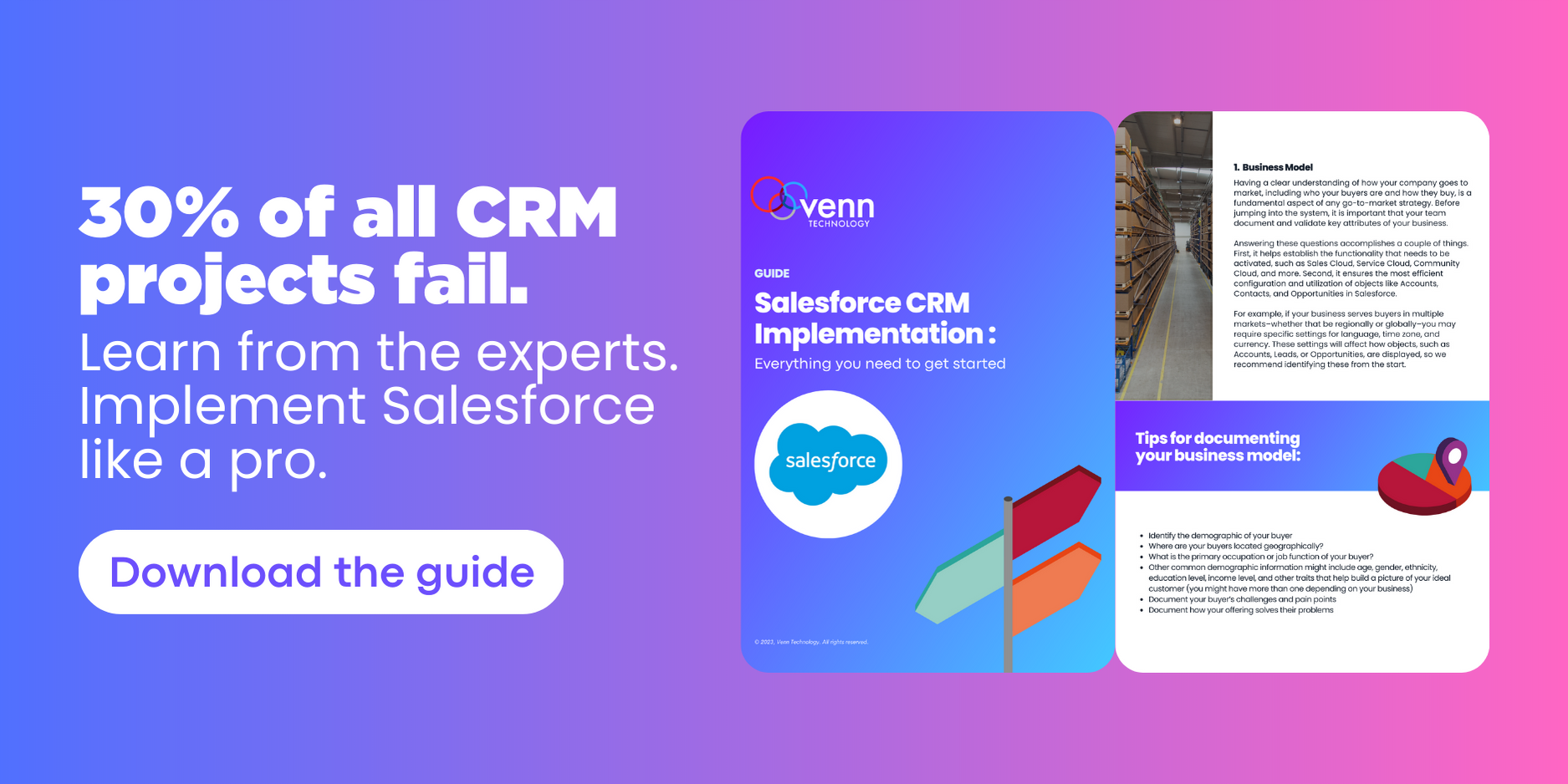
This can be a lot to understand, which is why we recommend downloading our full guide to Salesforce implementation.
Option 1: The DIY method
Who doesn’t love a good DIY project? It starts with an eye-catching post of your neighbor’s self-made coffee table in your social feed and then boom–you’re at the hardware store picking out stains.' Choosing to go this route may seem like the right response, but it comes with a lot of risks and trade-offs.
The first tradeoff is that relying on internal resources sucks the bandwidth from your team that is focusing on building the business.
Any successful implementation process requires input from subject matter experts in the business, but relying on them too heavily can lead to dips in productivity or worse-burnout–in other areas. This can have downstream impacts on the whole business. Resources become stretched as less and less of your time is spent working with
clients and customers, but handling fires and broken pipes in the house.
The second tradeoff is having to routinely fix, solve, and scale the software to your company's needs.
One of the biggest downfalls we see of any in-house implementation is configuring the solution for your business solely as it is today. As your business grows, you need your CRM to grow with it. Having to rebuild pieces can be draining for teams. Additionally, every error message or broken pipeline stalls the process and puts a wrench in your
team's plans. Having to constantly draw individuals away from their tasks to fix issues only slows things down further.
The third tradeoff is having to assign a team member the role of "Accidental Admin."
It is really common in smaller organizations and can become problematic as they continue to grow. Having access to Salesforce experts (through a partner) allows teams to focus on what they were hired to do. Unless your Admin is certified on Salesforce, it’s unlikely they were hired to manage it full-time.
On the other hand, leaning on a partner for ongoing maintenance and enhancements brings agility and industry experience. They’re staffed and ready to tackle your next project, allowing your internal teams to get the functionality they need without disruption.
Option 2: Use an Implementation Partner
If you buy a Porsche, you probably won’t take it to any old shop to perform maintenance on it. A Salesforce implementation should be treated no differently. Your business needs Salesforce implemented specifically for your workflows, and the Salesforce Platform has to be tuned to meet your specific needs to drive performance.
Odds are, you didn’t get into business to implement Salesforce. The good news: lots of other people did.
Choosing to implement Salesforce with a Partner has many of its advantages. The first (and hopefully most obvious) is access to experts in Salesforce.
Whether or not you have someone on your team who has administrative experience in Salesforce, the benefit of working with a partner is being able to leverage the combined experience across many industries and implementations.
The second advantage of implementation partners is gaining a fresh perspective on your business.
It can be easy when implementing a new technology to become so focused on what we want the result to be that we lose sight of whether or not our process for achieving it is the most efficient. There’s a ton of value that can come from having an outsider learn about your processes. As mentioned before, to implement Salesforce, it first requires
understanding your people, processes, and technologies.
The third advantage is implementing faster.
By going with an implementation partner, you have a team of people resourced and ready to tackle your project. Unlike the DIY approach, their job is to implement Salesforce so your teams can continue to focus on what they were hired to do with minimal disruption to the business. This almost always results in quicker implementations than the organization that self-implements.
| Read more: The 6 Phases of a Salesforce CRM Implementation
To learn more about Salesforce Implementation Partners, click the link above.
3. Preparing for Implementation (Kickoff)
Decided on what approach to go with? Great!
We’ve said it once before, and we’ll say it again: before you jump straight into implementation mode, you have some
homework to do to ensure your organization is ready for what it takes to be successful. First, you need to understand how these three components-people, process, and technology are interdependent.
To help you understand your people, process, and technology, we've prepared a few quick parts of the business and project for you to understand.
Business Model: A clear understanding of how your company goes to market, including who your buyers are and how they buy, is a fundamental aspect of any go-to-market strategy.
Processes: Every organization has its way of doing things. But just because you have processes in place, it doesn’t necessarily mean they are the most comprehensive or efficient.
Data: Just because you have the data, that doesn’t necessarily mean it needs to be moved into your new CRM.
Systems: Just like evaluating your processes can uncover areas for improvement in how your organization gets things done, taking regular inventory of your tech stack helps in identifying redundancies and places where it could be overspending.
Timeline: A typical Salesforce setup with little complexity should take no longer than three months, with more complex configurations spanning upwards of six months.
Stakeholders: The key stakeholders of any Salesforce project should include a decision-maker, project manager, and the business or end-users.
Security: The Salesforce security features help you empower your users to do their jobs safely and efficiently. Implement security controls that you think are appropriate for the sensitivity of your data.
Training & Adoption: You need to have a plan for training users on how to use the system and how to get the most out of it.
Budget: The cost to implement Salesforce CRM is dependent on several factors and can vary greatly from one company to another.
Support: Whether you have a team of in-house Salesforce developers and administrators or not, there will be costs
to maintain the system after deployment.
4. Building and Data Migration
If you've chosen the route of an Implementation Partner (hopefully with us), then during this time, our certified Salesforce experts build and configure your environment while addressing the specifications in the Project Requirements Document.
Recurring meetings continue throughout the Build phase to allow for feedback and iteration. Collaboration is pivotal to the success of the project, and ultimately, we rely on client input for the organization to succeed with its new CRM. Though these calls are often brief, our consultants conduct a demo of everything that’s been built in Salesforce to confirm we’re on the right track.
If you've chosen the Do-it-Yourself route, then it's time to assemble the team. Configuring things in Salesforce is declarative, meaning it uses native functionality and requires zero programming. However, with so much flexibility at your fingertips, it’s easy to make mistakes that can hurt your business down the road. The Porsche wasn't built to perform on a rocky road, and neither should you!
This process can take a while, so make sure that everything is locked down from stakeholders and project managers to the development team.
Data migration is the process of moving data from one system to another. From customer details to support tickets, data is everywhere, so it's important to understand what data is important and ensure that the data is transferred accurately and efficiently, without loss or corruption.
Just because you have the data, that doesn’t necessarily mean it needs to be moved into your new CRM. So, here are some tips on what to look for in data migration for Salesforce:
-
Document what data is collected, where it is collected, and how it is collected.
-
Identify and resolve duplicates.
-
Identify any missing fields.
-
Assess the age of your data.
-
Conduct an inventory of the size of your data.
5. Testing
Testing is one of the most important steps in a Salesforce implementation. You need to test the system thoroughly before going live to ensure it meets your business requirements and that everything is working as expected.
Thoroughly documenting your processes and requirements in the Discovery phase isn’t enough to ensure what’s built will work.
And, since you know your processes best, it’s important to get teams involved in testing early and often. Overlooking testing inevitably leads to frustration and delays the project.
If you have an Implementation partner, they might conduct User Acceptance Testing (UAT) with you, which consists of completing a list of action items and signing off that the system is ready for deployment into production.
6. Deploy!
Once everything is up to speed and the system is officially ready to launch. Now it's (almost) ready to be deployed. There is just one last thing to remember: you may have the rocket all ready to go and ready to hit that red button. But you also need the pilot, the support team, and the launch team ready and trained for this mission.
Training sessions, meetings, manuals, FAQs, and any activity that gets your team using the system before launch is crucial to mission success.
7. Hypercare and Support
When you work with a Salesforce partner (like Venn), deployment doesn’t mean hitting publish and leaving clients to figure out how to fly the ship. After everything goes live, we provide a two-week customer care period called Hypercare. Any issues that come up can be reported using the Bug Testing Form provided by a member of our project team.
After the two weeks, when businesses grow, they undergo many changes. In the final stage of the implementation process, we meet with our clients to discuss plans for future service and upkeep. It's important to understand that as businesses change and scale, so must the systems supporting them.
Service plans vary depending on the complexity of a given Salesforce environment, an organization’s growth, including new users, products, and a variety of other factors. It may also make sense to implement certain pieces of functionality or processes incrementally.
If you aren't working with a partner, having IT on standby for any support using the system within the few weeks of the launch date is crucial while onboarding staff.
Bringing it all together
Any CRM implementation comes with its challenges. If your organization needs help planning for a Salesforce implementation, Venn Technology can help. A certified Salesforce partner since 2015, Venn Technology has helped organizations of all shapes and sizes implement, customize, and maintain their investment in the platform.